Difference between revisions of "Honey market value chain"
| (8 intermediate revisions by the same user not shown) | |||
| Line 1: | Line 1: | ||
| − | A well-differentiated honey market value chain is equally important for producers, the distributors as well as for the | + | A '''well-differentiated honey market value chain''' is equally important for '''producers''', the '''distributors''' as well as for the '''consumers''' to provide '''uniform quality''' and further to '''increase the income'''. |
---- | ---- | ||
| − | |||
| − | '''Indonesia:''' According to a local scientist (Universitas Padjadjaran), fragments of a honey market chain exist, but work need to be done, to strengthen the value market chain. So far, beekeepers sell their products online in the form of bulk packaging by creating and marketing their own brand, or they offer it to | + | '''Ethiopia:''' Gemechis (2016) wrote about the domestic honey market value chain of Ethiopia: Crude honey is sold to '''collectors''' (nearest town/village markets) by small scale beekeepers. They pass on a great amount of the product to '''whole sellers''' in bigger cities and to local '''''tej'' breweries''' ('''[[honey]]'''). The whole sellers act as '''distributors''' and sell the honey to '''retailers''', '''''tej'' houses''', '''processors''' and '''consumers'''. <ref name="Gemechis 2016">Gemechis, L. Y. (2016). Honey Production and Marketing in Ethiopia. Agriculture And Biology Journal Of North America, 7(5), 248-253.</ref> Some beekeepers form '''marketing and producing cooperatives'''. They collect crude honey from members and sell the semi-processed product to processing companies or distributors. In 2013 there were nine registered honey processor companies in the country and some of them are also engaged in honey production. <ref name="MOA">MoA & ILRI (2013). Apiculture value chain vision and strategy for Ethiopia. Addis Ababa, Ethiopia: Ministry of Agriculture and International Livestock Research Institute.</ref> In Ethiopia, there is a lack of “good beekeeping practice”, thus, the cooperatives do not underlie quality controlling bodies, nor have business concepts and therefore suffer from '''quality loss''' and cannot compete with '''bigger companies''' (lack of proper collection, storage and transportation facilities; see '''[[biggest problems in beekeeping]]'''). In addition, the domestic honey market has several problems: the '''smuggle''' and '''adulteration''' of honey bee products, complaints of consumers about '''increasing prices''' of honey products, while the beekeepers have the feeling that the business is not rewarding. <ref name="Gemechis 2016"/> For local beekeepers, it is not common to separate table honey from beeswax and other ingredients, but during the ''tej''-brewing process, beeswax is separated as a '''byproduct''' that is passed on to '''[[beeswax]]''' collectors and exporters. Hence, they serve as important stakeholders in the beeswax business. <ref name="SNV 2005">SNV/Ethiopia (2005). Strategic intervention plan on honey & beeswax value-chains, snv support to business organizations and their access to markets (boam).</ref> About 10 percent of the produced honey in the country is not sold but consumed in the households. There are regions in Ethiopia, where not only 10%, but most of the honey is consumed by the beekeeping households. In a consequence, in those regions there are only fragments of, or no honey market chain at all. <ref>Serda, B., Zewudu, T., Dereje, M., & Aman, M. (2015). Beekeeping Practices, Production Potential and Challenges of Bee Keeping among Beekeepers in Haramaya District, Eastern Ethiopia. J Veterinar Sci Technol 6(255), 1-5.</ref> |
| + | |||
| + | |||
| + | '''Indonesia:''' According to a local scientist (Universitas Padjadjaran), '''fragments''' of a honey market chain exist, but work need to be done, to strengthen the value market chain. The honey market value chain is basically in the hands of the small scale beekeepers. So far, beekeepers (producers) sell their products '''online''' in the form of bulk packaging by creating and marketing their '''own brand''', or they offer it to '''collectors''' (i.e. distributors). In a next step, the collected products (honey, pollen, royal jelly, wax) will be further processed to adjust the quality of goods (flavor, water content, ...). Table honey is sold in '''bigger cities''' situated around the particular farms. Beekeepers also sell their honey to customers, who ordered it, by their own. The customers are mostly from the middle-and upper class and besides the honey's religious importance to the Islam, the upper class'es motives to buy honey are accompanied by believing in the healthy aspects of honey bee products. Most customers do not buy honey in the supermarket or at local markets, the there offered products are mostly of poor quality (adulteration, etc..). So far, there are no widely known and understood certifications that guarantee the quality of the bee products <ref name="Masterpole 2019">Masterpole, Z., Teleposky, E., Thompson, J., Zaghloul, S. (2019). Value Chain Analysis in Lampung Province, Indonesia. Retrieved from the University of Minnesota Digital Conservancy, URL (accessed: 20.11.2019): https://conservancy.umn.edu/bitstream/handle/11299/208595/Value%20Chain%20Analysis%20in%20Lampung%20Province,%20Indonesia.pdf?sequence=1.</ref> Some beekeepers hire agencies who promote and sell their honey. The agencies charge a fee on the actual honey price. Thus, the beekeepers do not, but the customers have to pay for the agencies' services. There is no information on the beekeeper, product processing, nor the product's origin on the labels. | ||
| + | |||
| + | <gallery widths=100px heights=300px mode="packed-hover"> | ||
| + | HoneyMarketValueChainExampleIND2019.JPG|center|400px|Example for a market value chain, rated as the one with the largest market potential in Lampung, Indonesia. Figure was retreived from Masterpole et al. (2019)<ref name="Masterpole 2019"/> | ||
| + | </gallery> | ||
| − | |||
| − | |||
| − | + | ==References== | |
| − | + | <references/> | |
| − | |||
| − | |||
| − | |||
| − | |||
| − | |||
| − | |||
| − | |||
| − | |||
| − | |||
| − | |||
| − | |||
| − | |||
| − | |||
| − | |||
| − | |||
| − | |||
| − | |||
| − | |||
Latest revision as of 10:22, 20 November 2019
A well-differentiated honey market value chain is equally important for producers, the distributors as well as for the consumers to provide uniform quality and further to increase the income.
Ethiopia: Gemechis (2016) wrote about the domestic honey market value chain of Ethiopia: Crude honey is sold to collectors (nearest town/village markets) by small scale beekeepers. They pass on a great amount of the product to whole sellers in bigger cities and to local tej breweries (honey). The whole sellers act as distributors and sell the honey to retailers, tej houses, processors and consumers. [1] Some beekeepers form marketing and producing cooperatives. They collect crude honey from members and sell the semi-processed product to processing companies or distributors. In 2013 there were nine registered honey processor companies in the country and some of them are also engaged in honey production. [2] In Ethiopia, there is a lack of “good beekeeping practice”, thus, the cooperatives do not underlie quality controlling bodies, nor have business concepts and therefore suffer from quality loss and cannot compete with bigger companies (lack of proper collection, storage and transportation facilities; see biggest problems in beekeeping). In addition, the domestic honey market has several problems: the smuggle and adulteration of honey bee products, complaints of consumers about increasing prices of honey products, while the beekeepers have the feeling that the business is not rewarding. [1] For local beekeepers, it is not common to separate table honey from beeswax and other ingredients, but during the tej-brewing process, beeswax is separated as a byproduct that is passed on to beeswax collectors and exporters. Hence, they serve as important stakeholders in the beeswax business. [3] About 10 percent of the produced honey in the country is not sold but consumed in the households. There are regions in Ethiopia, where not only 10%, but most of the honey is consumed by the beekeeping households. In a consequence, in those regions there are only fragments of, or no honey market chain at all. [4]
Indonesia: According to a local scientist (Universitas Padjadjaran), fragments of a honey market chain exist, but work need to be done, to strengthen the value market chain. The honey market value chain is basically in the hands of the small scale beekeepers. So far, beekeepers (producers) sell their products online in the form of bulk packaging by creating and marketing their own brand, or they offer it to collectors (i.e. distributors). In a next step, the collected products (honey, pollen, royal jelly, wax) will be further processed to adjust the quality of goods (flavor, water content, ...). Table honey is sold in bigger cities situated around the particular farms. Beekeepers also sell their honey to customers, who ordered it, by their own. The customers are mostly from the middle-and upper class and besides the honey's religious importance to the Islam, the upper class'es motives to buy honey are accompanied by believing in the healthy aspects of honey bee products. Most customers do not buy honey in the supermarket or at local markets, the there offered products are mostly of poor quality (adulteration, etc..). So far, there are no widely known and understood certifications that guarantee the quality of the bee products [5] Some beekeepers hire agencies who promote and sell their honey. The agencies charge a fee on the actual honey price. Thus, the beekeepers do not, but the customers have to pay for the agencies' services. There is no information on the beekeeper, product processing, nor the product's origin on the labels.
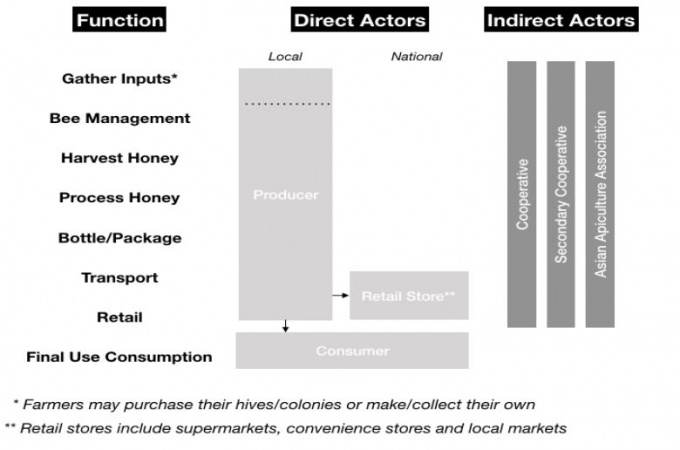
Example for a market value chain, rated as the one with the largest market potential in Lampung, Indonesia. Figure was retreived from Masterpole et al. (2019)[5]

References
- ↑ 1.0 1.1 Gemechis, L. Y. (2016). Honey Production and Marketing in Ethiopia. Agriculture And Biology Journal Of North America, 7(5), 248-253.
- ↑ MoA & ILRI (2013). Apiculture value chain vision and strategy for Ethiopia. Addis Ababa, Ethiopia: Ministry of Agriculture and International Livestock Research Institute.
- ↑ SNV/Ethiopia (2005). Strategic intervention plan on honey & beeswax value-chains, snv support to business organizations and their access to markets (boam).
- ↑ Serda, B., Zewudu, T., Dereje, M., & Aman, M. (2015). Beekeeping Practices, Production Potential and Challenges of Bee Keeping among Beekeepers in Haramaya District, Eastern Ethiopia. J Veterinar Sci Technol 6(255), 1-5.
- ↑ 5.0 5.1 Masterpole, Z., Teleposky, E., Thompson, J., Zaghloul, S. (2019). Value Chain Analysis in Lampung Province, Indonesia. Retrieved from the University of Minnesota Digital Conservancy, URL (accessed: 20.11.2019): https://conservancy.umn.edu/bitstream/handle/11299/208595/Value%20Chain%20Analysis%20in%20Lampung%20Province,%20Indonesia.pdf?sequence=1.
